
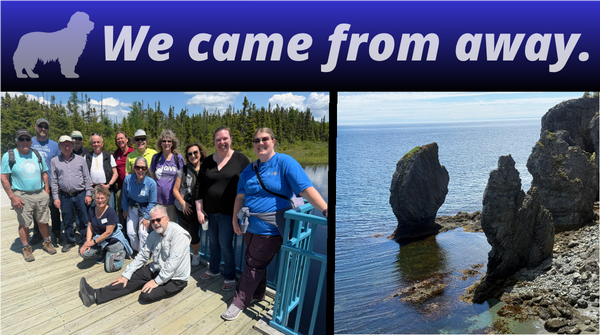
Eleven members of District 6250 traveled to Newfoundland for a Friendship Exchange filled with new connections, local culture and memorable experiences. Along the way, the group explored historic sites, visited Rotary projects and experienced firsthand the hospitality that has made Newfoundland famous.
From St. John’s to Clarenville and Gander, the journey offered plenty of opportunities to learn, serve and build lasting friendships. The group returned home as honorary Newfoundlanders after being “Screeched In,” a local tradition that included Screech rum, a few hard-to-repeat phrases and, of course, kissing a cod. Read more about their adventures and the connections they hope will bring their new Newfoundland friends to District 6250 in the future.
Hello,
Dave Clemens here. We recently completed our Friendship Exchange visit to Newfoundland, and what an experience it was. We hope our new friends will form a group and visit District 6250 in the future.
A group of 10 Rotarians and one “Rotarooter” from District 6250 came together in St. John’s, Newfoundland on June 21, 2026. Dave Clemens and Juli Mor (Wisconsin Dells), Lynn Perez-Hewitt and Jim Hewitt (Fitchburg Verona Horizons), Barbara Anderson and Warren Kerola (Menominee), Mick Holm (Waunakee), Sandee and Joel Macht (Watertown) and Jamie and Kevin Thielker (Holmen) were met by a group of hosts, led by Miriam Macleod at the Four Seasons Hotel near the city harbor.
We spent the first five days seeing the many historic and stunning sites around the capital city. This included a boat trip to see Bird Island, where more than a million seabirds, including puffins, were nesting. Humpback whales were feeding close to our boat, and the crew was very entertaining. We hiked to Cape Spear, where we stood at the easternmost point of continental America, and Signal Point. Downtown, along the harbor shore, we visited the War Memorial park and a Titanic museum and saw colorful buildings, ships of all shapes and sizes, and many restaurants and bars.
We took a ferry ride to Belle Island, where we were shown the biggest iron ore mine shafts in the world. It was a vital source during World War 2, and included a park to memorialize the only attacks on North American soil during the war. The Germans torpedoed and sank ore hauling ships.
We visited projects of the many local Rotary clubs. These included a splash pad, ice-skating trail, sports center, beach park and more. It made us proud to be Rotarians. We helped serve breakfast and lunch to the homeless at The Gathering Place, and pick up trash along a hiking and biking trail.
We moved on to the city of Clarenville, where the wonderful local Rotarian hosts first took us to tour a vintage car museum, where we discovered a trophy won at a car show in Wisconsin Dells. We enjoyed a local aquarium featuring local fish such as capelin, which were running while we were there and wolffish. The main attraction was the Skerwink Trail, which followed shoreline cliffs and bays and featured beautiful rock formations and forests.
We also visited the historic preserved community of Trinity, which offered a glimpse into how life was in the early years. Cod fishing built villages all along the coasts of Newfoundland, but the commercial fishery was shut down in 1982 due to low fish numbers. It has recently shown signs of recovery. And of course we ate at a colorful hillside brewpub.
That evening, we were treated to an amazing lobster, crab and mussel feast. It was a lovely evening, with Jim providing fiddle tunes.
We moved on to Gander for our third stop. This small community is famous for the hospitality they showed when 38 jets carrying nearly 7,000 passengers were grounded at the airport immediately after 9/11. The Broadway musical, Come From Away, which tells this story premiered on Broadway ten years ago and continues to be performed around the world.
It tells the true story through the experiences of Gander residents during the five days following the tragedy of 9/11. It’s an uplifting experience through their eyes of the many ways their small communities came together to house, clothe, feed, and provide showers for thousands of people, and their pets,who were stranded in their area for nearly a week. We visited two museums featuring the facts and stories of those days. Each driver who chauffeured us from site to site shared their personal story and enriched our stays.
We also hiked the wooden trail around Cobb’s Pond, where local Rotarians have built trails and shelters for people to enjoy. Later we visited the site of the 1985 Arrow Air crash, where 248 American service members returned from a peacekeeping mission and eight crew members lost their lives.
We returned to St. John’s for the final three days of our exchange. Newfoundlanders organize a formal Remembrance/Independence Day celebration on July 1. The morning is spent remembering the loss of life at Beaumont Hamel, at the battle of the Somme, during World War I. Newfoundland sent new troops to fight. Their first major battle was a disaster. They were ordered to rush toward German lines that were well entrenched. 900 soldiers were sent forward, only 68 replied to roll call the next morning. The afternoon is a celebration of their independence, although fireworks were cancelled due to dry conditions. We also enjoyed The Rooms, a large museum featuring natural history, local history and artwork. We headed for home on July 3.
One last note. We were named honorary Newfoundlanders by being “Screeched In” during a ritual ceremony at the Legion Hall in Gander. The ceremony included eating a strange piece of sausage, drinking a shot of cheap Screech rum, trying to repeat phrases spoken by locals in their unintelligible dialect, and finally kissing a cod.
We all returned as honorary Newfoundlanders. We have the certificates to prove it.