How Rotarians in India and Wisconsin Teamed Up to Transform Surgery for Thousands of India's Poorest Patients
Imagine you have a sharp pain in your abdomen. Your doctor says you need surgery. In most parts of the world, that means a relatively brief procedure, a small incision, a few days of rest, and back to life. But if you are a low-income patient in Surat, Gujarat, India, and the calendar says 2024, that same diagnosis might mean something different: a waiting list that stretches two to three months — and the very real possibility that by the time your turn arrives, you will simply opt for a far more invasive open surgery just to get it over with.
Bigger cuts. More pain. Longer hospital stays. Greater risk of complications.
That is the reality a dedicated group of Rotarians from two very different corners of the globe decided they simply could not ignore and the result is Rotary Global Grant GG2567576. This project is putting a state-of-the-art HD Laparoscopy Unit into the hands of surgeons at the New Civil Hospital in Surat, and in doing so, giving hundreds of patients every month the gift of a smaller scar, a faster recovery, and a fighting chance.
The Hospital That Never Sleeps
New Civil Hospital in Surat is a titan of public healthcare. Established in 1964, it now runs 1,230 beds, sees roughly 3,000 outpatients every single day, and admits around 200 inpatients daily — all free or at nominal cost to some of the most economically vulnerable people in western India. Patients pour in not just from Surat but from across Gujarat and the neighboring states of Maharashtra and Rajasthan, seeking care they simply cannot afford anywhere else.
The Department of Surgery handles between 750 and 900 laparoscopic procedures every month. Think about that for a moment — up to 900 minimally invasive surgeries, month after month, all funneled through a single laparoscopy system. Private hospitals in the same city charge between $1,200–$1,800 USD for the same procedures — a sum that might as well be the moon for the patients lining up at New Civil's doors.
One machine. Hundreds of patients a month. A queue that stretches for months. The math does not work — and sick people were paying the price.
Fort Atkinson Meets Surat Sea Face
Here is where the story takes a genuinely delightful turn. The international sponsor for this project is the Rotary Club of Fort Atkinson — a small city of about 12,000 people tucked into the rolling dairy farmland of Jefferson County, Wisconsin. On the surface, Fort Atkinson and Surat (population: 7 million) could not seem further apart. But Rotary has a knack for bridging exactly these kinds of gaps.
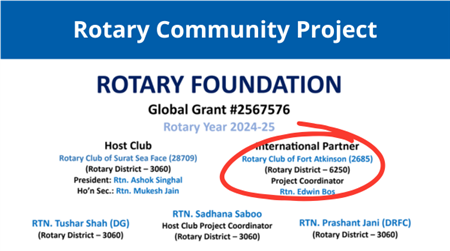
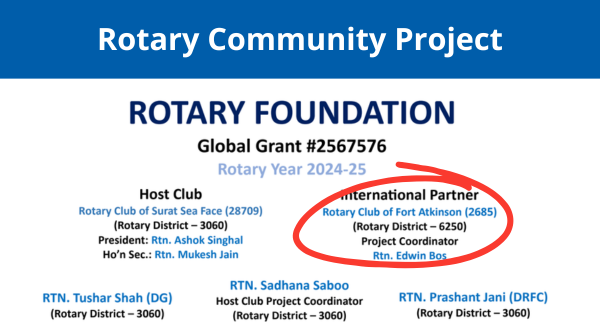
Leading the charge on the host side is Rtn. Sadhana Saboo of the Rotary Club of Surat Sea Face (District 3060), with co-support from Rtn. Dharmendra Jain, Rtn. Narendra Saboo, and Rtn. Savita Arya. On the Wisconsin side, Rtn. Edwin Bos of Fort Atkinson (District 6250) serves as international primary contact, joined by Rtn. Robert Bastien and Rtn. Tom Dehnert.
The partnership did not spring fully formed from thin air. The Surat team first walked the corridors of New Civil Hospital, talked to surgeons, counted the patients in waiting queues, and gathered hard data on operating costs and equipment capacity. When they brought that case to Fort Atkinson, the Wisconsin Rotarians immediately saw what the numbers meant in human terms — and they signed on.
A Machine Worth $31,000 — and So Much More
The centerpiece of the grant is a brand-new HD Laparoscopy Unit — a 3 CMOS HD system complete with telescope, video recorder, and CO₂ insufflator — procured from Unique Enterprises after competitive bidding and rigorous vetting of vendor track records, spare-part availability, and after-sales service commitments. The total hardware cost: about $30,665 USD. Add in administration, signage, and a small publicity budget for community outreach, and the total grant rings in at exactly $31,014.
Funding the project is itself a masterclass in Rotary's layered financing model. The Rotary Club of Surat Sea Face contributed $11,254 in cash; Fort Atkinson Rotary added $2,300; District 3060 contributed $7,400 in District Designated Funds; District 6250 pitched in another $2,300 in DDF. The Rotary Foundation's World Fund matched the balance with $7,760 — bringing the whole thing home at exactly the right number. The strong financial commitment by the host club and district reinforces that there is a real need and guarantees that monies will not be spent frivolously. This can happen when international clubs are contributing most or all of the money and the host club and district are only involved on paper.
The machine was recently handed over to the Department of Surgery and will be owned by New Civil Hospital — governed by Government Medical College, Surat — which has the in-house technicians, maintenance infrastructure, and institutional backing to keep it running for years to come. Vendor-supplied training covers operation, preventive maintenance, and breakdown response. Spares availability has been confirmed. This is not a grant that ends the day the ribbon is cut.
What a Second Machine Actually Means
It is easy to read "one additional laparoscopy unit" and file it away as a line item. But spend a moment imagining the ripple effect. A second machine running in parallel means the queue — that agonizing two-to-three-month wait — shrinks dramatically. Patients who previously faced the grim choice between waiting indefinitely or submitting to an open surgery can now get minimally invasive care in a reasonable timeframe.
Laparoscopic surgery versus open surgery is not a trivial distinction. Smaller incisions mean less post-operative pain, shorter hospital stays, faster return to work and family life, and dramatically reduced risk of wound infections and complications. For a daily laborer, a street vendor, or a farmer — the kind of patient New Civil serves — every day out of the hospital and back on their feet is income restored, family responsibilities met, and dignity preserved.
The grant monitoring plan commits to tracking results monthly, with the hospital maintaining a patient logbook and sharing data with Rtn. Sadhana Saboo. The goal is a clear, ongoing count of disease prevention interventions delivered — real accountability for real impact.
Rotary at Its Best
There is something quietly extraordinary about this project. A small town in Wisconsin and a bustling commercial metropolis on the coast of the Arabian Sea, united by the Rotary wheel and a shared belief that a person's ability to access minimally invasive surgery should not depend on their bank account.
The grant was approved and fully authorized by February–March 2025. Equipment ordered. Infrastructure already in place. The project timeline from order to commissioning: 60 days. Somewhere in Surat right now, a surgeon is preparing an operating theatre — and soon, a second HD laparoscopy system will hum to life, and the patient who would have waited three months will instead walk in, have their procedure, and walk back out into the world, a little faster and a little more whole.