Greetings, Rotarians,
For over a century, starting a Rotary club was a massive undertaking. You needed 20+ committed members, a full slate of officers, a constitution, and a significant amount of paperwork before you could even ring that first meeting bell.
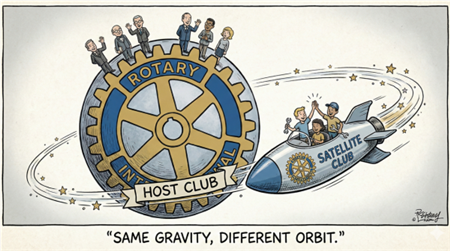
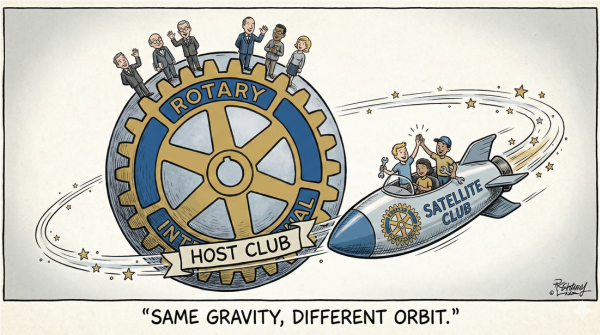
That high barrier to entry often stifled innovation. Enter the Satellite Club, known as Rotary’s "Minimum Viable Product."
If your traditional club is struggling to attract young parents, shift workers, or remote employees, do not change your meeting time. You will alienate your current members.
Instead, start a Satellite. It offers a completely different product to a completely different market, all while growing your club’s total membership count. It is the safest, smartest alternative in modern Rotary.
What is a Satellite Club:
Think of it as a "branch office" or a "sidecar" to an existing club. It is not a standalone club, but operates under the charter and protection of an existing "Sponsor Club."
Because it leverages the Sponsor Club’s infrastructure, it is incredibly easy to start. It allows a small group of people to function like a Rotary club by holding meetings, running projects, and inducting members without the administrative burden of a full charter.
The Core Mechanics
Minimum members: 8
Governance: By the Sponsor Club's board.
Finances: Uses the Sponsor Club's tax ID (EIN) and bank account (usually a sub-account).
Dues: Members pay RI and District dues, but Club dues are often significantly lower.
Meeting Format: Completely flexible. Can meet online, bi-weekly, or only for service projects.
Why a Satellite Club?
The Satellite model is the ultimate tool for market segmentation. It allows a traditional club a way to add new life without changing its own traditions.
1. The Young Professionals:
- Example: Young professionals can't leave work for 90-minute lunch meetings.
- Satellite Solution: A Satellite club meets Tuesdays at 6:00 PM at a brewery and focuses on hands-on service projects.
- Result: The traditional club keeps its lunch; the Satellite captures the demographic that couldn't attend.
2. The Cause-Based Pilot
- Example: There are five individuals interested in a “Veteran’s Support” Rotary Club but unsure if there is enough interest to create a new club.
- Satellite Solution: Start a "Veterans Satellite Club" after recruiting a total of eight members.
- Result: After time, the concept works and the satellite can spin into its own Rotary Club.
3. The Geographic Extension
- Example: A rural town is too small to support a full 20-person club but want the presence of Rotary in their community.
- Satellite Solution: The nearest larger city’s club can sponsor the Satellite in the nearby town.
- Result: Rotary establishes a footprint in a "service desert" with minimal risk.
How Satellites Become Standalone Clubs
- Phase 1 (The Launch): You start with 8 members. You are part of the Sponsor Club.
- Phase 2 (The Growth): You grow to 15-20 members. You are now functioning almost entirely independently.
- Phase 3 (The Flip): Once you hit the charter threshold (15 members), members can vote to "divorce" the Sponsor Club. They file for their own charter and become a standalone Rotary Club.
*Note: You never HAVE to separate. Stay Satellites forever because they enjoy having the Sponsor Club handle the taxes and administration.
The Pros and Cons of Satellite Clubs
Pros
Speed: Start next week with just 8 friends
Low Risk: If it fails, you just dissolve the committee; no legal mess.
Cost: No need to incorporate non-profit status or file tax returns (Sponsor does it).
Cons
Autonomy: You are technically subject to the Sponsor Club's board approval for big decisions.
Representation: Satellite members can vote in the Sponsor Club elections, which can sometimes cause friction if the groups have different cultures.
A Final Thought for Club Leaders
If your traditional club is struggling to attract young parents, shift workers, or remote employees, do not change your meeting time. You will alienate your current members.
Instead, start a Satellite. It offers a completely different product to a completely different market, all while growing your club’s total membership count. It is the safest, smartest alternative in modern Rotary.
Unite for Good,
Michael Kloss
District Governor 2025-26
Rotary Club of Eau Claire WI